
Credit Score Range 300–850: Bands, Models & How to Read a Score
FICO and VantageScore both run from 300 to 850. This is the reference for the whole scale: what each numeric band is called, roughly how U.S. consumers distribute across it, how the two scoring models differ, and how to read your own number. For guidance on what specifically counts as a 'good' score, see our separate guide.
Written by the MyITINCredit editorial teamReviewed Updated Editorial policyCorrections
Important Legal Notice
The information on this site is for informational and educational purposes only. It does not constitute legal, financial, credit, or professional advice. Comparisons, pricing, and recommendations are subject to change without notice. Verify current terms directly with the provider before making decisions. Credit results vary by individual. Consult a qualified advisor for personalized guidance. We assume no liability for decisions made based on this content.
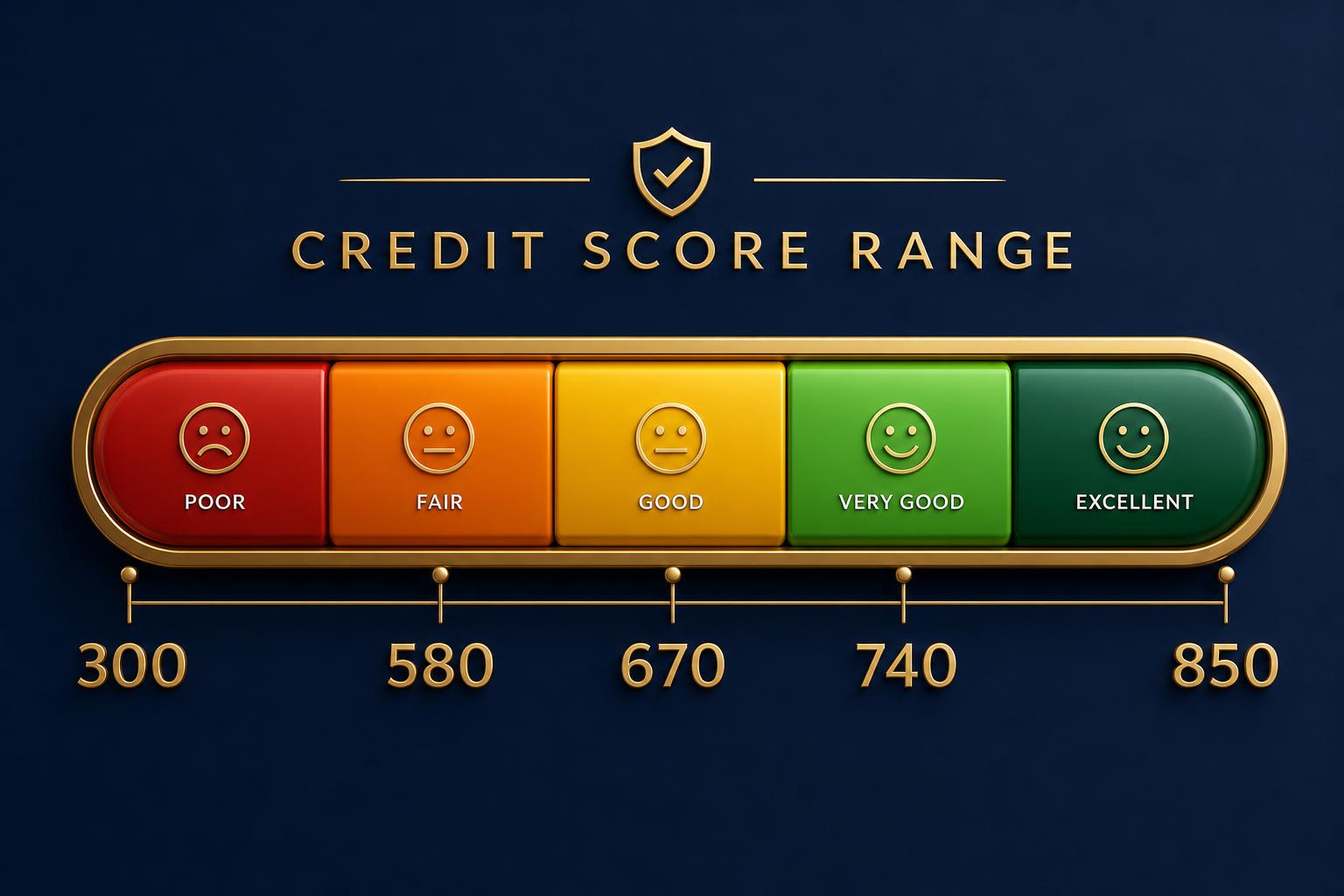
The 5 credit score tiers (FICO and VantageScore)
Per the FICO Score Distribution, both major U.S. scoring models use a 300–850 range divided into five tiers. The cutoffs are slightly different between FICO and VantageScore, but lenders treat them nearly identically.
300–579 — Poor (≈16% of U.S. files)
Almost no unsecured credit available. Auto financing only at 18%+ APR through subprime lots. No mortgage approval. Path forward: open one secured card + one credit-builder loan from a credit union, then 18 months of clean reporting.
580–669 — Fair (≈17% of files)
Subprime credit cards approve (high APRs, low limits). FHA mortgage possible at 580+ with 3.5% down. Auto rates 12–18%. Apartments approve with extra deposit. Below 600, expect a co-signer requirement on most leases.
670–739 — Good (≈21% of files, the U.S. median lives here)
Where the median U.S. consumer (717) sits. Prime credit cards approve. Both FHA and conventional mortgages available. Auto rates 6–9%. Apartments approve without extra deposits. Most rewards cards target this band.
740–799 — Very Good (≈28% of files)
The first tier where you get the best rate available — not just an approval. Premium rewards cards (Sapphire Preferred, Amex Gold) target this band. Conventional mortgage at the lowest published rate. Auto financing at 4–6%.
800–850 — Exceptional (≈21% of files)
Diminishing returns. A 760 and an 820 are charged the same rate by most underwriters. Where 800+ unlocks something extra: jumbo mortgages, private banking, and white-glove card tiers (Amex Platinum, Chase Sapphire Reserve).
What each credit score range unlocks — by product
| Score | Credit card | Auto APR | Mortgage |
|---|---|---|---|
| 300–579 | Secured only | 18–25% | Not approved |
| 580–669 | Subprime unsecured | 12–18% | FHA only |
| 670–739 | Prime rewards | 6–9% | FHA + Conventional |
| 740–799 | Premium rewards | 4–6% | Best published rate |
| 800–850 | White-glove | 3–5% | Jumbo tier |
See where your credit score sits today — 3 bureaus, daily
$1 for 15 days — then choose monthly, quarterly, or yearly. Cancel anytime.
- 3-Bureau credit reports & scores
- Daily monitoring & alerts
- Identity theft protection
- Score simulator & insights
- $1 for 15 days trial
- Cancel online anytime
- 3-Bureau credit reports & scores
- Daily monitoring & alerts
- Identity theft protection
- Score simulator & insights
- $1 for 15 days trial
- Cancel online anytime
- 3-Bureau credit reports & scores
- Daily monitoring & alerts
- Identity theft protection
- Score simulator & insights
- $1 for 15 days trial
- Cancel online anytime
FICO vs VantageScore — same range, different math
Both use 300–850 but weight the inputs differently. FICO 8 is a single-day snapshot. VantageScore 4.0 uses 24-month trended balance data and is more forgiving on isolated late payments. VantageScore often reads higher than FICO on the same file; the exact gap varies. The lender's score is the one that matters; VantageScore is your early-warning system.
We wrote an SSN-specific version of this guide with the key nuances and differences.
Read guideHow to move up one tier — fastest moves by starting point
- Poor (300–579) → Fair: open one secured card + one credit-builder loan; 6 months of on-time payments.
- Fair (580–669) → Good: drop utilization under 30%, add one more account, no new late payments for 6 months.
- Good (670–739) → Very Good: utilization under 10%, no hard inquiries for 6 months, age your file.
- Very Good (740–799) → Exceptional: 7+ years of perfect payment history; utilization under 7%; never close oldest account.
Related guides
- What is a "good" credit score — definition & lender context →
- ITIN credit score — same range, ITIN file →
- SSN credit score range — full breakdown →
- FICO score explained →
- VantageScore vs FICO compared →
Cards and tools targeted at each credit score tier
Personal Loan Offers
See loan options from trusted partners based on your credit profile.
Credit Builder Cards
Designed to help establish or improve your credit history.
Credit Card Offers
Explore cards that match your credit standing and goals.
Get an ITIN Number
Learn how to apply for or renew your ITIN today.
Use code Simplyapproved50 at checkout for ITIN setup savings.
Form Your LLC
Launch your U.S. LLC with formation, EIN, and banking support.
Save 30% at checkout with code DOOLASAM30.
Bank Account Options
Access checking and savings accounts from reputable institutions.
Simply Approved Mortgages
ITIN-friendly home financing from Simply Approved Mortgages, a Simply Approved Corporation brand.
Frequently asked questions about credit score ranges
What's a good credit score?
FICO and VantageScore both consider 670+ 'Good', 740+ 'Very Good', and 800+ 'Exceptional'. The U.S. median FICO 8 is 717, which sits in the Good tier.
What's the highest possible credit score?
850 on FICO 8/9 and VantageScore 3.0/4.0. Roughly 1.7% of U.S. credit files reach 850. Diminishing returns kick in around 760 — most lenders price a 760 and an 820 identically.
What's the lowest credit score?
300 on FICO and VantageScore. Most consumers with thin files start around 500–550 once their first tradeline reports — true 300s usually reflect long bankruptcy + multiple charge-offs.
Why is my VantageScore higher than my FICO?
VantageScore 4.0 is more forgiving on isolated late payments and uses 24-month trended balance data. FICO 8 is a single-day snapshot. VantageScore often reads higher than FICO 8; the exact gap varies by file.
What credit score do I need for a mortgage?
FHA accepts 580 with 3.5% down. Conventional needs 620+. Best published rates start at 740. Mortgage underwriting uses the middle of FICO 2/4/5 — the 'trimerge' — so optimize the lowest bureau score.
How do I move my credit score from one tier to the next?
Poor → Fair: open 1 secured card + 1 builder loan. Fair → Good: drop utilization under 30%, add 1 account. Good → Very Good: under 10% utilization, no late payments, 1 hard pull / year. Very Good → Exceptional: 7+ years of clean history.
Quick credit tools
Try them now. Nothing you type is saved.
Using a smaller share of your available credit generally helps your score. This is an educational estimate.
Why does credit monitoring matter?
Short answer: it lets you see what lenders see, fix errors, and spot fraud early — especially useful when you're building credit with an ITIN.
The 3 bureaus can show different data
Equifax, Experian and TransUnion don't always receive the same information, so your score can differ between them.
Errors happen — and you can dispute them
If you spot a wrong account, name or address, you have the right to dispute it with the bureau.
Catch suspicious activity sooner
Alerts about new accounts or inquiries help you react quickly to possible fraud.
See whether your effort is working
Tracking your score month to month shows if on-time payments and low balances are paying off.
Source: FTC — Disputing errors on your credit reports. MyITINCredit is educational; reports, scores and monitoring are provided by MyFreeScoreNow.
Start your credit monitoring today
$1 for 15 days — cancel anytime.