ITIN Credit Score: How It Works, How to Check It, and How to Build One (2026)
An ITIN credit score is a standard U.S. credit score (VantageScore 4.0 or FICO 8/9) generated on a credit file opened under your ITIN instead of a Social Security Number. Same math. Same 300–850 range. Same FCRA protections. Here's exactly how ITIN credit scores work, how to check yours across all three bureaus, and how to build one from zero.
Written by the MyITINCredit editorial teamReviewed Updated Editorial policyCorrections
Important Legal Notice
The information on this site is for informational and educational purposes only. It does not constitute legal, financial, credit, or professional advice. Comparisons, pricing, and recommendations are subject to change without notice. Verify current terms directly with the provider before making decisions. Credit results vary by individual. Consult a qualified advisor for personalized guidance. We assume no liability for decisions made based on this content.
What is an ITIN credit score?
An ITIN credit score is a standard U.S. consumer credit score calculated on a credit file that is opened and maintained under an Individual Taxpayer Identification Number (ITIN) issued by the IRS, rather than a Social Security Number. Equifax, Experian, and TransUnion apply the identical VantageScore 4.0 and FICO 8/9 formulas to ITIN files that they apply to SSN files. There is no "ITIN-only" scoring model, no lower ceiling, and no special range — the score runs 300–850 like every other U.S. credit score.
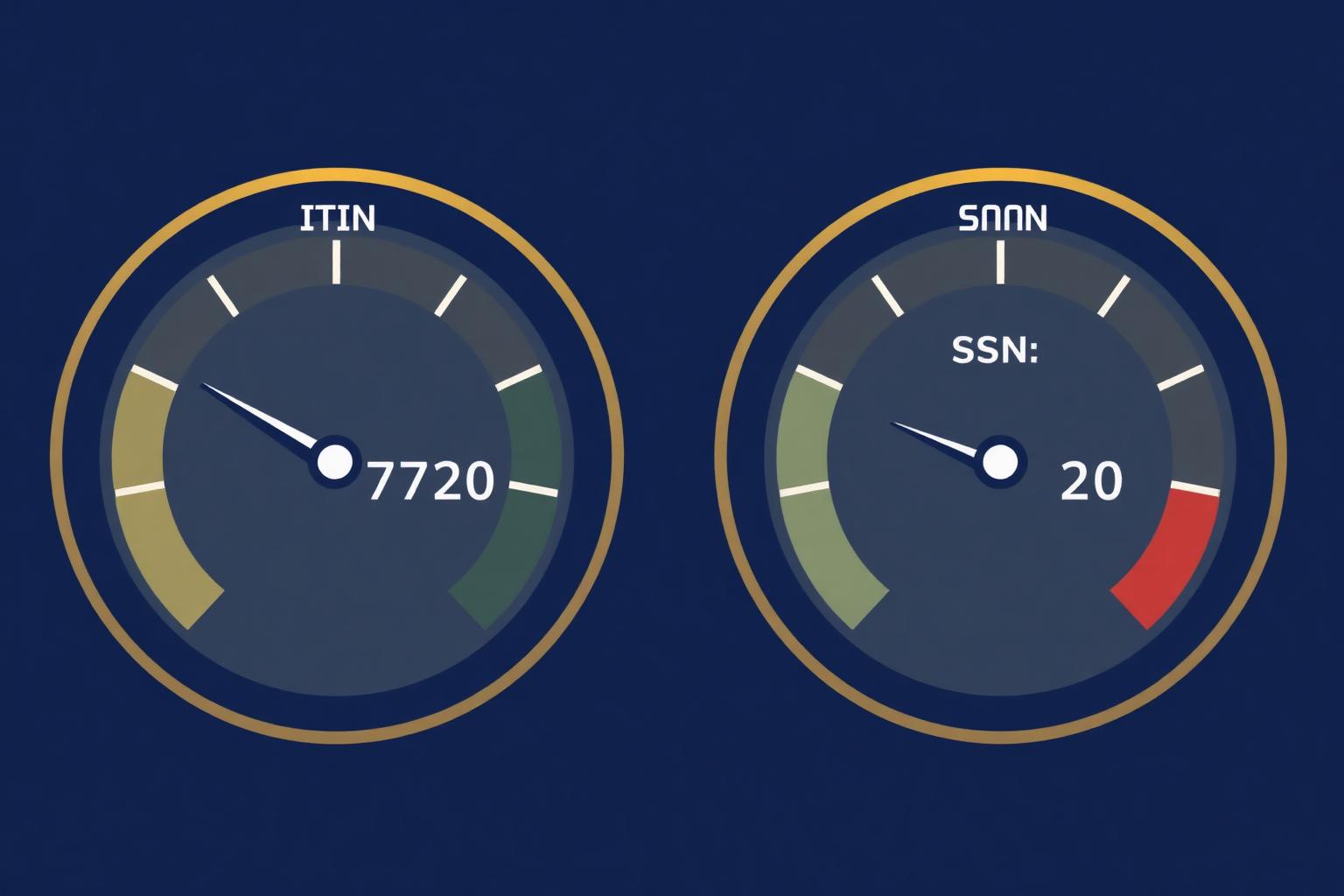
When you apply for credit with an ITIN, the bureaus open a file keyed to your ITIN + full legal name + date of birth + address. That file is scored by the exact same algorithm as an SSN file. A 720 on an ITIN file is identical in predictive power — and unlocks the same approval tiers — as a 720 on an SSN file.
ITIN credit report — how to pull all 3 bureaus
Your ITIN credit report is the underlying record that generates the score. Every ITIN holder is entitled to a free ITIN credit report from each of the three nationwide bureaus — Equifax, Experian, and TransUnion — once every 12 months at AnnualCreditReport.com, the only site authorized by federal law. If AnnualCreditReport rejects the request because it can't verify your identity through an SSN-based knowledge quiz, mail Form 15-100 with a copy of your ITIN letter (CP565), government-issued photo ID, and a recent utility bill to each bureau directly.
For daily 3-bureau ITIN credit reports and score updates — instead of once a year — MyITINCredit pulls Equifax, Experian, and TransUnion refreshable every 24 hours on the same dashboard, with VantageScore 4.0 on every pull.
ITIN number credit score — starting points and growth
A brand-new ITIN number credit score typically appears within 30–60 days of your first reporting tradeline. VantageScore 4.0 requires only one open account with one month of history, so an ITIN-friendly secured card that reports to all three bureaus generates your first ITIN number credit score in the 580–650 range within a single billing cycle. FICO 8/9 needs six months of history before it produces a score, so most ITIN files show a VantageScore first and a FICO score at month 6.
Growth is not identifier-limited. With on-time payments and utilization under 10%, most disciplined ITIN holders cross 700 within 12–18 months — the same trajectory as an SSN holder starting from zero. See the full 12-month ITIN credit-building playbook for the exact tradeline stack that gets you there.
Same math, different file
When you apply for credit with an ITIN, the bureaus open a file under your ITIN + name + date of birth + address. That file is scored by the exact same algorithm as an SSN file. A 720 on an ITIN file is identical in predictive power — and unlocks the same approval tiers — as a 720 on an SSN file.
What drives the gap in practice
| Factor | Typical ITIN file (year 1) | Typical SSN file (year 1) |
|---|---|---|
| Tradelines | 1–2 | 2–4 |
| Average age | 3–6 months | 6–18 months |
| Credit mix | Often revolving-only | Revolving + installment more common |
| Inquiries | Higher (more denials before finding ITIN-friendly issuer) | Lower |
| Result | Score lands 30–80 points lower | Score reflects same payment behavior |
How to close the gap fast
- Open a second tradeline of a different type (installment if you only have revolving).
- Keep statement-date utilization <10% on every revolving account.
- Stop applying — let inquiries age off (they affect score for 12 months, stay on file 24).
- Pull all three bureaus monthly; dispute any error under FCRA Section 611.
- Add Experian Boost or a rent-reporting service for thin-file lift.
Track every score change daily — ITIN or SSN
$1 for 15 days — then choose monthly, quarterly, or yearly. Cancel anytime.
- 3-Bureau credit reports & scores
- Daily monitoring & alerts
- Identity theft protection
- Score simulator & insights
- $1 for 15 days trial
- Cancel online anytime
- 3-Bureau credit reports & scores
- Daily monitoring & alerts
- Identity theft protection
- Score simulator & insights
- $1 for 15 days trial
- Cancel online anytime
- 3-Bureau credit reports & scores
- Daily monitoring & alerts
- Identity theft protection
- Score simulator & insights
- $1 for 15 days trial
- Cancel online anytime
Getting an SSN later — protect the score you built
Write to each bureau with copies of your ITIN letter (CP565), the new SSA card, government-issued ID, and a recent utility bill. Ask them to merge the ITIN file under the SSN. Per the FCRA, the bureaus must respond within 30 days. Do this before opening any new account on the SSN — otherwise the new account creates a parallel thin file and your history is split.
We wrote an SSN-specific version of this guide with the key nuances and differences.
Read guideDoes the bureau know the difference between an ITIN and SSN?
Technically, yes — the bureau stores the identifier with the file. But the scoring model never looks at the identifier. VantageScore 4.0 and FICO 8/9 only consume tradeline-level data: payment history, balances, age, mix, and inquiries. A 720 is a 720 regardless of which 9-digit number anchors the file.
What the identifier actually controls
- Which lenders report to your file (ITIN-friendly furnishers report under ITIN; SSN-only furnishers don't).
- Which lenders pull your file (some underwriting platforms still hard-block ITIN applications).
- File merging when you transition from ITIN to SSN.
Why ITIN scores trend lower in year 1 — and how to flip it
The thin-file penalty
VantageScore 4.0 penalizes files with fewer than 3 tradelines. ITIN holders in their first 12 months typically sit at 1–2 tradelines, costing roughly 30–50 points purely from file depth — not behavior.
The inquiry tax
ITIN applicants get declined more often before finding an ITIN-friendly issuer, racking up unnecessary hard inquiries. Always confirm ITIN acceptance with the issuer's underwriting team before applying.
The mix gap
Most ITIN holders open a secured card first and stop there. Add a credit-builder loan in months 4–6 to unlock the credit-mix factor — typical lift is 10–25 points within 60 days of the installment line reporting.
FICO vs VantageScore — what your lender actually pulls
| Lender type | Score they usually pull | Bureau preference |
|---|---|---|
| Mortgage (ITIN or SSN) | FICO 2, 4, 5 (classic) | Tri-merge, lowest middle |
| Auto loan | FICO Auto 8/9 | Equifax / Experian |
| Credit card | VantageScore 4.0 or FICO 8 | Varies by issuer |
| Personal loan / fintech | VantageScore 4.0 | TransUnion most common |
| Rental / apartment | VantageScore 4.0 | Experian RentBureau |
Transitioning ITIN → SSN without losing your score
The file merge process
- Write a letter to each bureau (Equifax, Experian, TransUnion) requesting they merge your ITIN file under your new SSN.
- Enclose: copy of your IRS CP565 ITIN letter, copy of your SSA card, government-issued photo ID, and a current utility bill.
- Bureaus must respond within 30 days per the FCRA.
- Confirm by pulling a new report under the SSN and verifying tradeline ages match.
What can go wrong
If you open a new account on your SSN before requesting the merge, the bureau may create a parallel thin file. Once that happens, merging is harder and some history can be lost. Always merge first.
Related guides
- ITIN credit score — full guide →
- ITIN credit report — 3 bureaus →
- VantageScore vs FICO — which lenders use →
Trusted partner offers for ITIN & SSN users
Personal Loan Offers
See loan options from trusted partners based on your credit profile.
Credit Builder Cards
Designed to help establish or improve your credit history.
Credit Card Offers
Explore cards that match your credit standing and goals.
Get an ITIN Number
Learn how to apply for or renew your ITIN today.
Use code Simplyapproved50 at checkout for ITIN setup savings.
Form Your LLC
Launch your U.S. LLC with formation, EIN, and banking support.
Save 30% at checkout with code DOOLASAM30.
Bank Account Options
Access checking and savings accounts from reputable institutions.
Simply Approved Mortgages
ITIN-friendly home financing from Simply Approved Mortgages, a Simply Approved Corporation brand.
Frequently asked questions — ITIN vs SSN scores
Is there a separate scoring model for ITIN files?
No. Equifax, Experian, and TransUnion run VantageScore 4.0 and FICO 8/9 on every file the same way. The model doesn't look at whether the identifier is an ITIN or an SSN — only at tradeline data, payment history, utilization, age, mix, and inquiries.
Why is my ITIN score lower than my friend's SSN score?
Almost always file depth, not the identifier. ITIN holders typically have fewer tradelines, less age, and a smaller pool of reporting lenders early on. With the same inputs you'd get the same score.
Can a mortgage lender pull my score using my ITIN?
Yes, and most ITIN mortgage programs do. They typically pull a tri-merge report and require a 660+ middle score. Confirm the bureau and model with the loan officer before applying.
What happens to my score when I get an SSN?
Nothing automatically. You must write to each bureau requesting a file merge. With the merge done correctly your full ITIN history carries over and your score is preserved. Skip the merge and you start over with a thin file under the SSN.
Does using MyITINCredit show the same score a lender sees?
We show VantageScore 4.0, the model used by the majority of credit-card and personal-loan lenders. Mortgage lenders pull FICO and the FICO score may differ by 10–40 points either way. Use VantageScore to track trend; pull FICO before any mortgage application.
Is FICO 10 or FICO 10T available for ITIN files?
Yes — same as SSN files. FICO 10T (the trended-data version) uses 24 months of balance trends and treats ITIN and SSN files identically. Adoption is slow industry-wide; most ITIN-friendly lenders still pull FICO 8 or VantageScore 4.0.
Why might my ITIN score show 'No Score' even with an active tradeline?
FICO requires the account to be open at least 6 months AND updated within the last 6 months. New ITIN tradelines hit VantageScore (which has no minimum age) first. Wait until month 6 and FICO 8 generates automatically.
Can ITIN and SSN files at the same bureau ever merge automatically?
No. Bureaus require a written merge request from you with documentation: ITIN letter from the IRS, new Social Security card, government photo ID, and proof of address. Process takes 30-60 days. Without the request, the files stay separate forever.
Do hard inquiries on an ITIN file expire faster than on an SSN file?
No — both stay on the file for 24 months and stop affecting the score after 12. The rules are identical. Plan major ITIN applications (mortgage, auto) at least 12 months after your last credit-card or builder-loan application.
Is a 700 ITIN credit score harder to reach than a 700 SSN credit score?
No — the path is the same: 12-18 months of on-time payments, utilization under 10%, 3+ tradelines, and one account aged 24+ months. ITIN holders sometimes reach 700 faster because they start with no negative history to overcome.
Do prepaid debit cards build either ITIN or SSN credit?
No — neither. Prepaid cards don't extend credit, so there's nothing to report. Some prepaid programs add a 'credit-builder' feature (Chime Credit Builder, Cleo Builder) that does report — verify with the issuer before signing up.
Quick credit tools
Try them now. Nothing you type is saved.
Using a smaller share of your available credit generally helps your score. This is an educational estimate.
Why does credit monitoring matter?
Short answer: it lets you see what lenders see, fix errors, and spot fraud early — especially useful when you're building credit with an ITIN.
The 3 bureaus can show different data
Equifax, Experian and TransUnion don't always receive the same information, so your score can differ between them.
Errors happen — and you can dispute them
If you spot a wrong account, name or address, you have the right to dispute it with the bureau.
Catch suspicious activity sooner
Alerts about new accounts or inquiries help you react quickly to possible fraud.
See whether your effort is working
Tracking your score month to month shows if on-time payments and low balances are paying off.
Source: FTC — Disputing errors on your credit reports. MyITINCredit is educational; reports, scores and monitoring are provided by MyFreeScoreNow.
Start your credit monitoring today
$1 for 15 days — cancel anytime.